
To buy or sell on this platform, you must be registered as an active Buyer or Seller. Sign up to activate your account and start trading today.
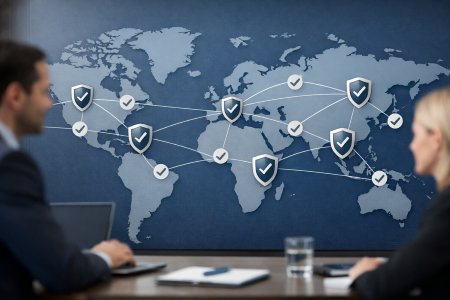
International B2B trade has expanded rapidly over the past decade. Digital platforms, cross-border logistics, and remote negotiations have made global sourcing easier than ever.
However, increased accessibility has also increased exposure to fraud.
In 2026, common B2B risks include:
For procurement teams in the UK, EU, and USA, fraud prevention is no longer reactive. It is a strategic priority.
Confidence is not assumed. It must be engineered.
A verified network is a structured environment where:
Verification does not eliminate risk entirely.
It reduces uncertainty.
And in international trade, reducing uncertainty increaseas decision sepeed.
Fraud thrives in environments where:
Verified networks reduce fraud by introducing structure and traceability.
Clear company data makes impersonation more difficult.
Inconsistent listings and vague positioning are common red flags. Structured profiles make irregularities easier to detect.
Centralized communication channels reduce manipulation through off-platform negotiation.
Defined payment mechanisms reduce exposure to advance-fee fraud and delivery disputes.
Fraud relies on ambiguity.
Verification reduces ambiguity.
Procurement teams evaluate suppliers based on:
Working inside verified networks allows Buyers to:
In many UK and EU companies, supplier verification has become mandatory before onboarding.
Confidence is procedural, not emotional.
Verification benefits Sellers as much as Buyers.
Verified Sellers experience:
In global B2B, visibility alone is insufficient.
Credibility drives conversion.
Sellers operating in structured, verified environments signal professionalism before the first message.
International transactions introduce additional layers of complexity:
Verified networks reduce friction by creating:
In 2026, global trade is not defined by reach alone.
It is defined by structured trust.
Businesses choosing verified environments gain:
As fraud prevention becomes more important in international procurement, verified networks are evolving from optional features to structural necessities.
Confidence increases trade velocity.
And velocity drives growth.
No risk. Just Business.
Share this article on: